
Integrated
Governance
Consideration of ESG issues
and business ethics
In line with the Middlenext Code, Société de la Tour Eiffel embeds ESG considerations at the highest level of corporate decision-making. Its Board of Directors, dedicated ESG Committee and ESG & Innovation Department together form a robust governance framework designed to steer, oversee and monitor the Company’s sustainability strategy and non-financial performance.
Board of Directors Composition
Board Members
16
14 directors
2 non-voting Board members
Gender balance
50% / 50%
Women and Men
on the Board of Directors
Independence
50%
Independent Directors
(Middlenext Code)
Executive Members
0%
Full Separation Between
Governance and Executive Management
The Board is supported by four specialised committees:
Audit Committee (3 members), nomination and Remuneration Committee (3 members), investment Committee (5 members) and ESG Committee (4 members), chaired by Christine Sonnier, Independent Director.
Dedicated ESG Governance Structure

ESG Committee (Board Committee)
Established in 2022, the ESG Committee oversees the Company’s sustainability strategy, approves ESG action plans, and monitors the implementation of the ESG risk management programme. 5 meetings held in 2025 (target: ≥ 3)

ESG & Innovation Departmen
Established in 2022, the ESG & Innovation Department embeds ESG considerations across operational and support functions, ensuring a cross-functional approach to sustainability. It has also led the Company’s ESG Committee since 2014

Internal CSR Committee (involving the Executive Management)
13 sessions held in 2025 (target: ≥ 10), during which each material IRO is linked to an action plan and an approved target.

Double materiality assessment completed in 2025
Comprehensive analysis of material Impacts, Risks and Opportunities (IROs) integrated into the strategy and decision-making processes.
ESG integrated into remuneration
The annual variable remuneration of the Executive Management is indexed at 20% to ESG performance criteria defined by the Board of Directors, based on the recommendation of the Nomination and Remuneration Committee. These criteria cover: improving the energy consumption performance of the portfolio, optimising construction and refurbishment projects, and training employees on ESG-related issues.
All employees benefit from variable remuneration of 20% based on ESG objectives specific to each department, defined individually in relation to the material IROs within their scope of responsibility.
ESG Governance Indicators – ESG Management
-
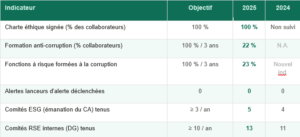
5 ESG Committees (Board of Directors) in 2025 — target ≥ 3, exceeded for the second consecutive year
-
13 internal CSR Committees (Executive Management) in 2025 — target ≥ 10, exceeded
-
100% of employees signed the internal Code of Ethics
-
Dual ISO 9001 and ISO 14001 certification maintained in 2025 (since 2015)
-
Green credit facility with Crédit Agricole Île-de-France, indexed to ESG performance indicators
-
ESG training session for female Board members planned for 2027

Ethical and responsible
business conduct
Inspired by the United Nations Global Compact, Société de la Tour Eiffel’s ethics policy covers the fight against corruption, the prevention of conflicts of interest, whistleblower protection and tax transparency. In 2025, no alerts were reported.
Signed Ethics Charter
100%
Of all employees in
2025
Alerts reported
0
In 2025 – operational whistleblowing procedure in place
Anti-corruption training
22%
In 2025
(three-year cycle – 100% in 2023)
Ethics frameworks in place
Internal Ethics Charter (French version only) since 2016 : inspired by the United Nations Global Compact, it covers human rights, working conditions, the environment and the fight against corruption. Signed by 100% of employees and Executive Management.
External Ethics Advisor (since 2023): available to all employees, providing confidential and anonymised advice on any ethical matters, including corruption. Reports to Executive Management on an anonymised basis.
Independent External Ethics Officer: provides guidance to employees and Board members regarding the risks of insider trading. Awareness training is provided upon joining the Company.
Whistleblowing Procedure (Sapin II Law): mandatory and operational. Each new joiner signs the onboarding booklet containing the Ethics Charter and the whistleblowing policy.
Employees and Board members are made aware of the risk of insider trading upon joining the Company. A compliance officer acts as an advisor to anyone requiring guidance on this matter.
Anti-corruption training is organised through a three-year cycle covering 100% of employees (100% achieved in 2023). In 2025, 22% of employees received training on ethics and professional conduct, and 23% of high-risk roles received dedicated training (new 2025 indicator).
Each new joiner receives an onboarding booklet including the Ethics Charter and compliance policies. Internal investigations may be conducted by the Human Resources and Legal Departments, with the support of the external Ethics Officer.
Société de la Tour Eiffel is committed to ensuring an ethical, respectful and integrity-driven professional environment. Several confidential and anonymous reporting channels are available:
External reporting: You may contact our external Ethics Officer at any time via the dedicated and secure email address: referentethique.toureiffel@gmail.com
Internal whistleblowing officers: Employees may also contact the internal whistleblowing officers, available within the Legal Department (l.rivoal@stoureiffel.com) and the Human Resources Department (t.rouillard@stoureiffel.com).
These exchanges are strictly confidential and may remain anonymous if you wish.
As a beneficiary of the SIIC tax regime, the Company is not liable for corporate income tax. Taxation is fully transferred to shareholders through dividends, which are reported to the French Tax Administration (DGFiP) by the custodian bank for all shareholders, regardless of their tax residence. The risk of tax evasion does not apply to this model.

Our targets
Number of ESG Committees (under the Board of Directors) in 2025
2025 results: +1 vs 2024
Target: 3/year
ESG Committee established in April 2022
5/year
Number of internal CSR Committees involving Executive Management
2025 Results: +2 vs 2024
Target: 10/year
13/year
Percentage of employees who have received training on corruption
2025 Results: 100%
2026 Target: 100%
100%

The Board of Directors
Operational teams